How to Choose a Paper Cup Supplier for Your Business
The right paper cup supplier meets your service needs with clearly identified products and understandable ordering arrangements. A listed price or a resemblance between catalogue photographs is not enough to make that decision.
For cafés, restaurants, hotels and packaging distributors, a structured comparison helps uncover differences before an order is placed. Here is a practical way to compare suppliers and build a purchasing process your team can follow from day to day.
Define a requirement suppliers can compare
Before requesting prices, describe the drinks, portions and accessories involved. Record current sizes, actual usage and the problems you want to solve. A replacement project becomes clearer when it identifies the issue, such as limited storage, too many references or a cup that does not suit a recipe.
Separate essential requirements from preferences. Suitability for the intended use may be non-negotiable, while a particular graphic arrangement may be optional. This avoids rejecting a useful proposal over a minor detail or accepting a product that misses the main requirement.
Send the same brief to the suppliers being considered. Their responses can then be assessed against a common starting point. Where information is missing, you can request clarification rather than compare offers built around different assumptions.
Compare complete product references
Capacity alone is not enough. Ask about beverage use, diameter, described construction and the associated lid. Keep the information in a table where each row identifies one specific product.
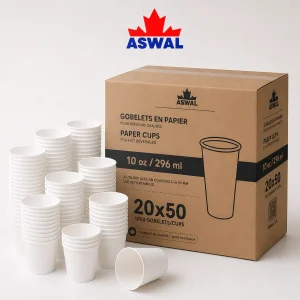
ASWAL’s 12 oz Hot Paper Cup, 16 oz Hot Paper Cup and 20 oz Hot Paper Cup provide several capacities to review in the hot range. The 16 oz Cold Paper Cup belongs to a separate use category. Evaluate these references against your recipes rather than assuming they can be substituted for one another.
| Criterion |
What to compare |
Mistake to avoid |
| Product |
Reference, capacity, diameter and use |
Comparing only “small” and “large” |
| Lid |
Model and confirmed combination |
Assuming universal compatibility |
| Quantity |
The same stated requirement in each offer |
Comparing different volumes |
| Customization |
Artwork, formats and arrangements |
Comparing plain stock with printed cups |
| Delivery |
Destination and proposed service |
Leaving part of the scope out |
Clarify responsibility at each stage
Ask whether the company manufactures cups, distributes products or coordinates several partners. Different purchasing models can suit different businesses, but responsibilities should be clear. Identify who handles product questions, artwork approval and order follow-up.
ASWAL presents its paper cup manufacturing in Montreal. If origin is part of your purchasing criteria, request the details for the selected products and retain them. Do not automatically extend a cup’s origin statement to every accessory in the order.
Observe the quality of communication while the quote is being prepared. Specific answers and clearly identified outstanding questions provide useful evidence about how the relationship may work. General reassurances are less helpful when your team needs an exact reference or an approval decision.
Make sample evaluation useful
If a sample is available, involve the people who will use the product. Prepare normal recipes, use the intended lid and review storage at the workstation. Follow your establishment’s handling procedures throughout the check.
Record the product reference, recipe and observations. A difficulty may relate to the portion, an accessory or the cup itself; enough context is needed to discuss it. Avoid a broad conclusion from a trial whose conditions no one can describe later.
A service trial does not replace technical documentation where your purchase has a specific requirement. Request the information needed for that requirement. A favourable impression from a sample should not be converted into a certification claim or a general performance guarantee.
Compare the complete proposal
Bring together the confirmed cost elements for an equivalent scope. Cups, lids, any customization and delivery should be identifiable in the proposal as applicable. Read the associated terms at the same time as the amount, rather than after the supplier has been selected.
Ask how changes in quantity, format or artwork will be handled. If repeat orders are expected, establish what needs to be reconfirmed. An initial offer should not be treated as a permanent commitment covering every future purchase regardless of changes.
Include receiving and storage requirements in the decision. Requested volumes should be manageable for the space and staff available. This is worth discussing even when the cup itself fits the beverage menu perfectly. A product decision and a workable stock plan belong together.
Keep printed projects organized
For branded cups, identify the files, colour references and person responsible for approval. Ask what steps are required between the initial idea and the confirmed order. Keep rejected concepts separate from the version that has received approval.
Design My Cup helps show the intended logo placement. It does not replace confirmation of printing options and production artwork. The supplier should be able to understand exactly what your team has approved and what remains open for review.
If several brands or locations are involved, centralize their comments. Consistent instructions make the buyer’s requirements easier to follow and reduce ambiguity in the relationship. Designate one person to communicate the consolidated decision rather than forwarding conflicting feedback from several sources.
Agree on follow-up after delivery
Before the first order, ask how to report a discrepancy and what information to provide. Plan to check references, quantities and carton condition at receiving. Keep the details needed to trace the purchase and explain any issue.
After several orders, review what has actually happened: document clarity, responses to questions, correct product references and suitability of the range. Separate observations from impressions and discuss problems using specific examples.
A simple review sheet may be enough. The purpose is to retrieve decisions, identify changes and avoid restarting the whole selection process with every reorder. If a problem recurs, the record also helps explain its context to the supplier without relying on memory.
Choose a supplier that fits your operation
Paper cup sourcing involves the full relationship: products, compatibility, customization, the commercial proposal and follow-up. Explore ASWAL’s catalogue, prepare your reference list and request a quote with the quantities and operating requirements you have identified. You can then assess the response against the criteria that matter to your business rather than choosing on appearance or unit price alone.