Before they reach our hands at a café counter, paper cups go through a precise manufacturing chain, calibrated to the millimeter and built around strict food safety standards. Behind their apparent simplicity are specialized materials, surface treatments, and highly automated machines. Here is, step by step, how paper becomes a reliable, leak resistant cup that is ready to use.
From paper to cups: materials and key steps
It all starts with choosing the right paperboard, typically made from certified virgin fibers such as FSC or PEFC, to ensure food contact suitability, mechanical strength, and hygiene. This is not standard printer paper. Its density, stiffness, and porosity are engineered so it can be formed into a cone without cracking and without absorbing liquids too quickly. To help limit migration and deliver clean print results, the paperboard may also receive a controlled surface coating.
Next comes the leak barrier, which is essential because paper alone is not waterproof. Traditionally, a very thin polyethylene layer is extruded onto one side of the board. It provides leak protection and enables heat sealing. Depending on the market and sustainability requirements, alternatives are growing in use, including water based dispersion coatings, biopolymers such as PLA, and reduced plastic barriers that can improve recyclability in paper focused systems.
Before forming, the paperboard is printed using flexography or offset, with food compliant inks and often UV or LED drying. The artwork is aligned to the future cup dieline, accounting for curvature and the overlap at the side seam. The printed board is then converted into precisely sized rolls, ready for cutting into blanks that will become the cup wall.
Cutting, forming, and sealing: production
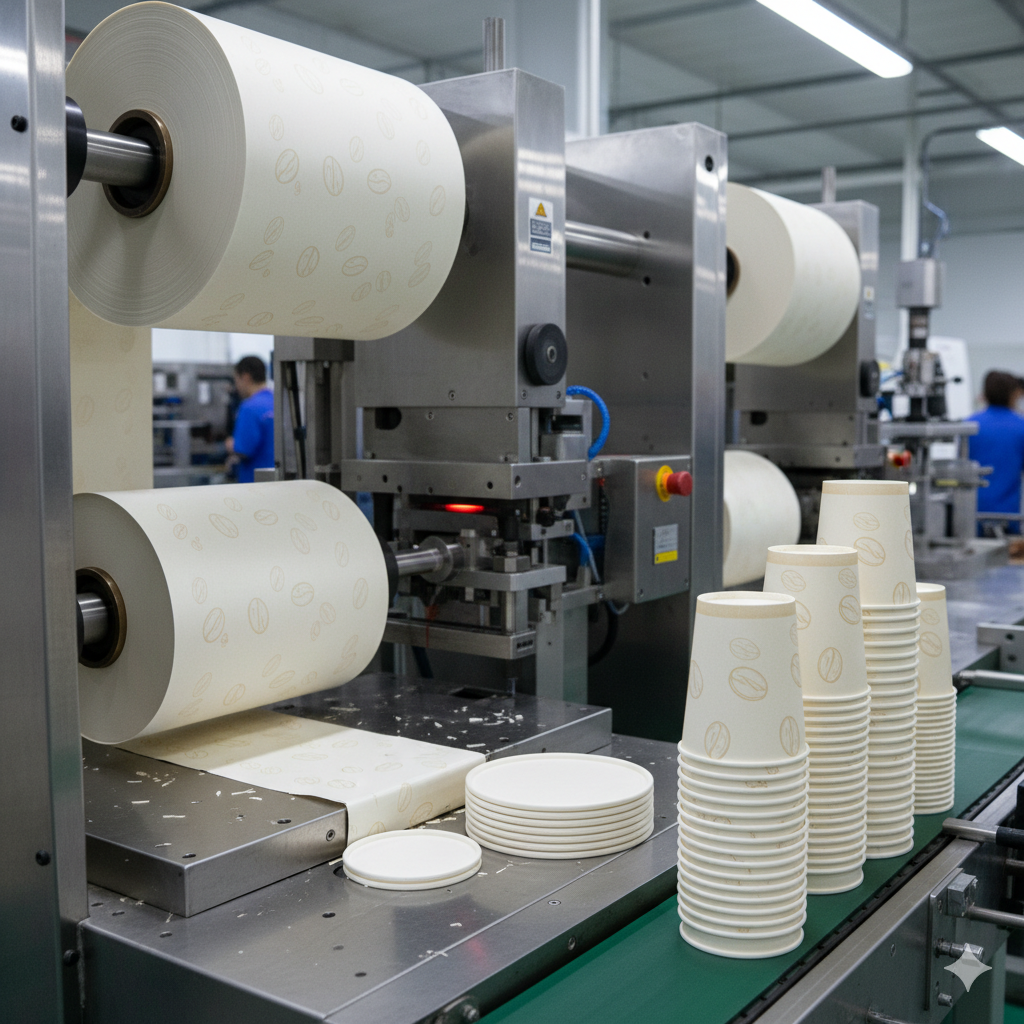
Production begins with die cutting. This creates wall blanks shaped like a curved wedge, where the radius and angle determine the final volume, from 4 oz up to 20 oz and beyond. In parallel, bottom discs are cut. Their diameter is slightly larger than the inner cup diameter to allow a tight, leak resistant seam. Paperboard waste is typically collected and returned into internal recycling streams.
Forming happens on high speed cup machines that can reach roughly 100 to 300 units per minute depending on size. The sidewall blank is wrapped into a cone, then closed with a vertical seam, either by adhesive bonding using water based or hot melt glues, or by heat sealing when the barrier layer melts and fuses. The bottom disc is inserted and crimped in place, while targeted heating stations help secure the seal. A rim rolling step then curls the top edge to create a smooth, strong lip.
Quality controls run throughout the line: leak tests using pressure or fill methods, checks on dimensions, crush strength, stackability, and surface cleanliness. Depending on the use case, such as hot drinks, cold drinks, or double wall insulation, forming parameters, board thickness, and barrier choice vary. Before final packing into sleeves, hygiene steps such as ionized air or UV treatment may be applied. The cups are then packed into cartons, labeled for traceability, and shipped.
Behind every paper cup is a precise process where materials, surface treatments, and machine control work together to deliver safety, leak protection, and comfort in use. Today, innovation focuses on barriers that are easier to recycle and on lower carbon manufacturing methods. The result is an everyday object that is highly engineered and constantly evolving to meet consumer expectations and regulatory change.